
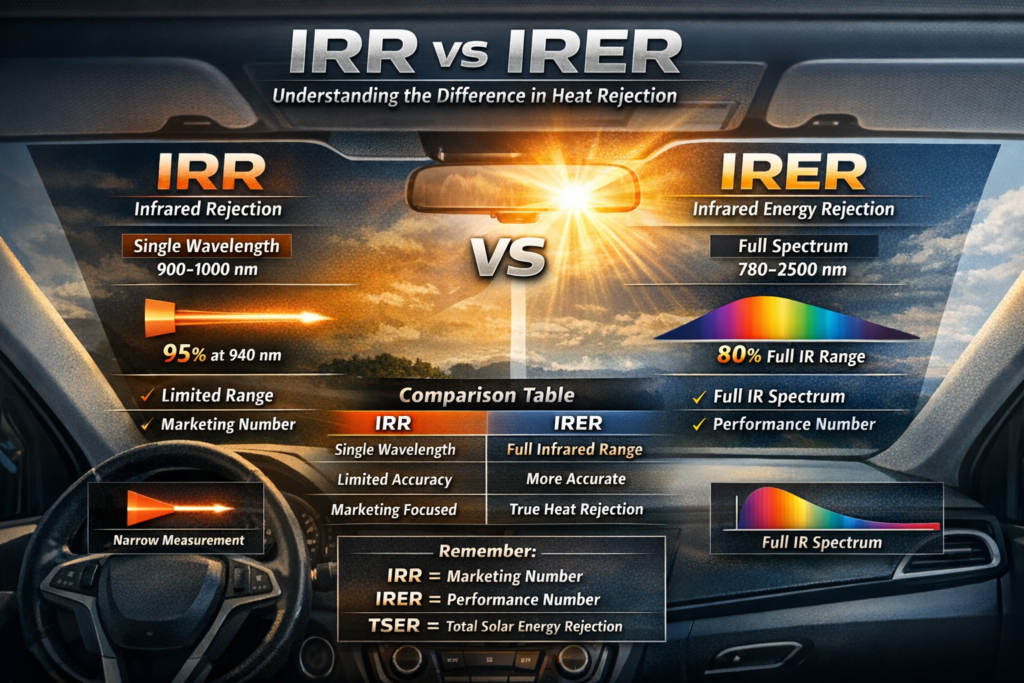
If you’ve been researching window tint specifications, you’ve probably come across two terms that sound very technical:
IRR – Infrared Rejection
IRER – Infrared Energy Rejection
Many customers — and even some installers — assume both are the same. They are not. Understanding this difference is very important when choosing the right window tint, because these numbers directly relate to how much heat your film actually blocks.
Let’s break this down in simple terms.
First, What is Infrared (IR)?
Sunlight is made up of:
- UV rays (cause skin damage, fading)
- Visible light (what we can see)
- Infrared radiation (HEAT)
Infrared is the main reason your car gets hot.
Not visible light. Not UV. Mostly Infrared heat.
So when we talk about heat rejection, we are mainly talking about infrared rejection.
What is IRR (Infrared Rejection)?
IRR measures how much infrared radiation is blocked at a specific wavelength, usually around 900–1400 nm.
Simple explanation:
IRR is a single-point measurement.
It does not measure the entire heat spectrum — only one small part of it.
Example:
A film may advertise:
IRR = 95%
Sounds amazing, right? But this 95% may be measured only at 940 nm, not across the full infrared range.
This is why IRR alone can sometimes be misleading if used for marketing without context.
What is IRER (Infrared Energy Rejection)?
IRER measures how much total infrared heat energy is rejected across the full infrared spectrum (780 nm to 2500 nm).
This is a much more realistic measurement of actual heat rejection performance.
Simple explanation:
- IRR = One point
- IRER = Whole infrared range
So IRER is the more honest real-world heat rejection number.
Real-Life Analogy
Think of it like this:
- IRR = Your marks in one subject
- IRER = Your overall average marks
Which one tells the real story?
Overall average → IRER
Same logic applies to window films.
IRR vs IRER – Comparison Table
| Feature | IRR | IRER |
|---|---|---|
| Full form | Infrared Rejection | Infrared Energy Rejection |
| Measurement | Single wavelength | Full IR spectrum |
| Accuracy | Less accurate | More accurate |
| Marketing use | Very common | Used in premium films |
| Real heat rejection indicator | No | Yes |
Then What is TSER?
To make things clearer, there is one more important term:
TSER – Total Solar Energy Rejection
This includes rejection of:
- UV
- Visible light
- Infrared
So:
- IRR → Small part of IR
- IRER → Full IR heat
- TSER → Total heat from sun
In simple terms:
| Metric | What it Measures |
|---|---|
| IRR | Infrared at one wavelength |
| IRER | Total Infrared heat |
| TSER | Total solar heat |
What Numbers Should You Look For?
When choosing a high-performance nano ceramic film, look for:
- IRER: Above 60%
- TSER: Above 55%
- UVR: 99–100%
- Glare Reduction: Based on VLT
If a brand only advertises IRR but not IRER, always ask for:
- Spectral chart (780–2500 nm)
- TSER report
- Test report source
Because true heat rejection performance is not measured by IRR alone.
Final Conclusion
If you remember just one thing from this article, remember this:
IRR is a marketing number. IRER is a performance number. TSER is the real-world number.
So when choosing a window tint, don’t just ask:
- “What is the IRR?”
Instead ask:
- “What is the IRER?”
- “What is the TSER?”
That’s how you choose the right film.
About EVOFILMS-EVOTINT
EVOFILMS nano ceramic films are engineered to deliver:
- High IRER for real heat rejection
- High TSER for cooler cabins
- 100% UV protection
- Clear visibility
- Long-term durability
EVOFILMS – Drive the future, with EVOlutionary protection.