The Biggest Myth in the Automotive Tint Industry
Most people believe:
“The darker the tint, the cooler the cabin.”
It sounds logical.
A dark room feels cooler. Dark sunglasses reduce brightness. So naturally, darker films should reject more heat… right?
Wrong.
Darkness and heat rejection are two completely different things.
A film can look extremely dark and still allow huge amounts of heat into the cabin.
Understanding Sunlight: The Real Science
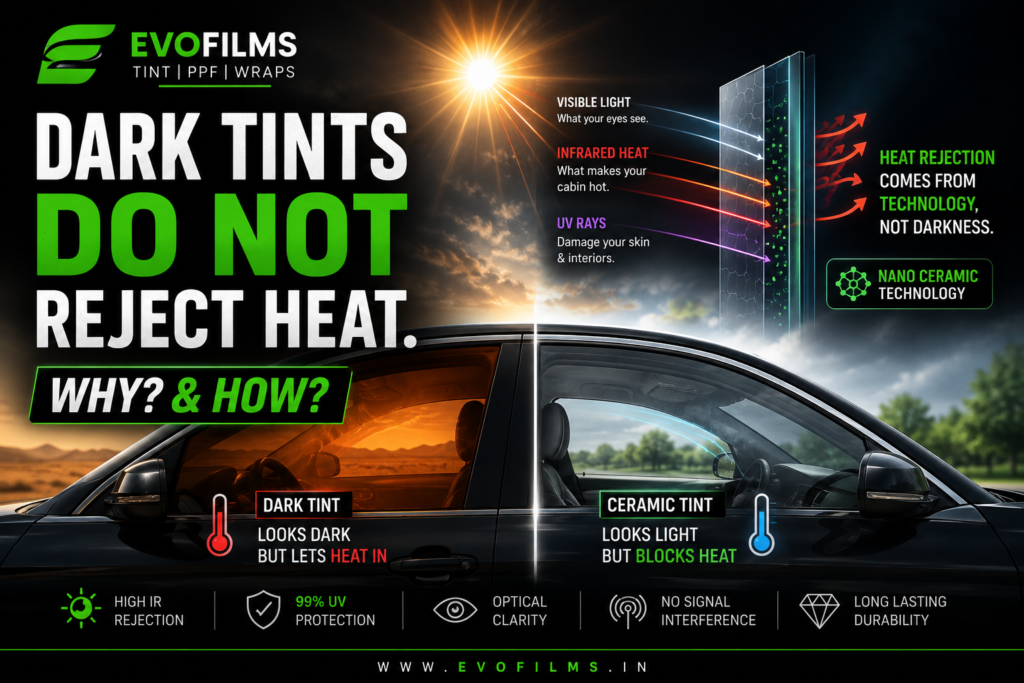
Sunlight is made up of 3 major components:
| Component | Effect |
|---|---|
| UV Rays | Damages skin & interiors |
| Visible Light | Brightness your eyes see |
| Infrared Radiation (IR) | Main source of heat |
The important part?
Infrared radiation creates most of the cabin heat.
So a good window film should not simply make the glass darker.
It should block infrared energy.
Why Cheap Dark Films Fail
Most cheap dark films are simply dyed polyester.
They:
- reduce brightness
- improve privacy
- darken the cabin
…but they do NOT effectively reject infrared heat.
Instead:
- they absorb heat
- the glass becomes hot
- heat transfers inside the car
That’s why many cars with extremely dark tints still feel unbearable in Indian summers.
Visual Comparison: Darkness vs Heat Rejection


6
The Real Difference: Dyed vs Nano Ceramic Films
Cheap Dyed Film
- Dark appearance
- Basic glare reduction
- Poor IR rejection
- Fades over time
- Traps heat
Nano Ceramic Film
- Can be light or dark
- High infrared rejection
- Better cabin cooling
- Stable performance
- No signal interference
- Superior clarity
Here’s The Shocking Truth
A lighter premium ceramic film can reject MORE heat than a darker cheap film.
For example:
| Film | Darkness | Actual Heat Rejection |
|---|---|---|
| Cheap Dyed Film | Very Dark | Low |
| Nano Ceramic Film | Medium Shade | Very High |
This surprises most customers because they judge performance visually instead of scientifically.
Real-World Example
Think about clothing.
A black cotton shirt becomes hot quickly under sunlight.
But a high-tech sports jacket with reflective technology stays cooler even if it isn’t dark.
Window films work the same way.
Technology matters more than colour.
Infrared Rejection Explained Visually


9
Understanding VLT
Darkness is Measured by VLT
VLT = Visible Light Transmission
Lower VLT means:
- darker appearance
- less visible light entering
But VLT does NOT measure heat rejection.
Example:
| Film | VLT | IR Rejection |
|---|---|---|
| 5% Dark Film | Very Dark | 35% IR |
| 50% Ceramic Film | Light | 95% IR |
The second film will feel dramatically cooler.
What Actually Matters When Buying Tint?
Instead of asking:
“How dark is it?”
Ask:
1. IRR (Infrared Rejection)
How much infrared heat is blocked.
2. IRER (Infrared Energy Rejection)
Real-world heat performance.
3. TSER (Total Solar Energy Rejection)
Overall solar heat rejection.
4. UV Rejection
Protection for skin, leather, dashboards, and plastics.
Why Premium Films Cost More
High-performance films require:
- nano ceramic technology
- multi-layer construction
- advanced adhesives
- optical engineering
- UV stabilizers
- infrared-selective materials
That’s why genuine premium films cannot be sold at unrealistically cheap prices.
If someone offers:
“Full nano ceramic tint for ₹5,000”
you should question:
- actual IR performance
- durability
- clarity
- authenticity
Heat Testing & Cabin Comfort


7
Why Even Dark Cars Still Feel Hot
Window film is only one part of thermal management.
Heat also enters through:
- windshield exposure
- metal roof panels
- dashboard radiation
- ambient temperature
- engine heat
So true comfort depends on:
- film technology
- installation quality
- glass coverage
- overall vehicle insulation
The EVOFILMS Philosophy
At EVOFILMS, we focus on:
- scientifically tested performance
- real infrared rejection
- optical clarity
- stable adhesives
- premium nano ceramic technology
- long-term durability
Because true comfort is not about making the cabin darker.
It is about making the cabin cooler.
Final Verdict
Dark tint reduces brightness.
Technology reduces heat.
Those are NOT the same thing.
The future of automotive window films is:
- smarter films
- selective heat rejection
- nano ceramic technology
- higher infrared performance
Choose EVOfilms, Choose Quality!