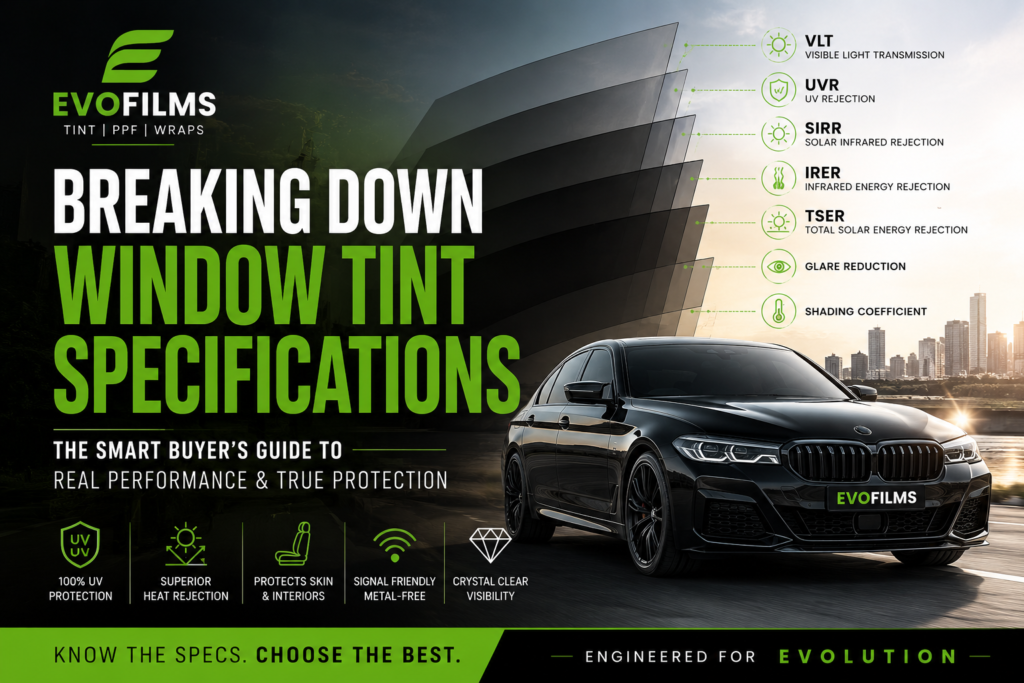
The Smart Buyer’s Guide to Understanding VLT, TSER, IRER, UV Protection & Real Heat Rejection
Most people buy window tints based on only one thing:
“How dark does it look?”
But here’s the reality:
Darkness does NOT equal heat rejection.
In fact, many cheap dark films perform worse than premium lighter nano ceramic films.
That’s why understanding window tint specifications is extremely important before choosing a film for your car.
At EVOFILMS, we believe customers deserve transparency, not confusing marketing terms.
So let’s break down the real meaning behind tint specifications — in simple language.
Why Window Tint Specifications Matter
Modern automotive films are no longer just cosmetic accessories.
A high-quality nano ceramic sunfilm should help with:
- Heat rejection
- UV protection
- Cabin comfort
- Skin protection
- Reduced glare
- Better driving comfort
- Interior preservation
But not all specifications carry equal importance.
Some numbers are marketing-heavy.
Some are genuinely useful.
Understanding the difference helps you choose smarter.
1. VLT (Visible Light Transmission)
What it means:
VLT measures how much visible light passes through the film.
Example:
- 70% VLT = lighter film
- 20% VLT = darker film
Common Misunderstanding:
People often assume:
“Darker film means better cooling.”
That is completely false.
A cheap dark dyed film can still allow large amounts of heat inside the cabin.
Meanwhile, a lighter nano ceramic film may reject significantly more heat.
EVOFILMS Insight:
Choose VLT based on:
- Driving comfort
- Visibility preference
- Aesthetic preference
- Day/night usability
NOT based purely on heat rejection assumptions.
2. UVR (UV Rejection)
What it means:
UVR indicates how much harmful ultraviolet radiation is blocked.
UV rays are responsible for:
- Skin damage
- Interior fading
- Leather cracking
- Dashboard deterioration
Why It Matters
Long drives under Indian sunlight expose both:
- Passengers
- Interior materials
to harmful UV radiation daily.
The EVOFILMS ET Series provides:
100% UV Rejection
That’s why we call it:
Skin Care Sunfilms.
3. SIRR (Solar Infrared Rejection)
What it means:
SIRR measures rejection of infrared heat from sunlight.
Infrared radiation is one of the biggest reasons why car cabins become unbearably hot.
Higher SIRR =
- Better heat blocking
- Cooler interiors
- Reduced AC load
EVOFILMS ET Series:
Offers:
- Up to 98% SIRR
which helps maintain better thermal comfort even during extreme Indian summers.
4. IRR vs IRER — The Most Confusing Specification
This is where most brands confuse customers.
IRR (Infrared Rejection)
IRR usually measures a narrow infrared wavelength range.
Many brands advertise:
- 95%
- 97%
- 99% IRR
But this alone does not always represent real-world cabin comfort.
IRER (Infrared Energy Rejection)
IRER is more realistic.
It measures:
- Infrared energy absorbed
- Infrared energy transmitted
- Re-radiated heat into the cabin
This gives a more practical understanding of actual heat rejection performance.
Why IRER Matters More
Two films may both advertise:
- 99% IRR
But still perform differently in real life.
That’s why IRER is a far smarter metric for serious buyers.
5. TSER (Total Solar Energy Rejection)
One of the most important real-world specifications.
TSER measures:
Total overall solar heat rejected by the film.
This includes:
- Visible light energy
- Infrared energy
- UV energy
Higher TSER = Better Overall Comfort
Benefits include:
- Cooler cabin
- Reduced heat soak
- Improved AC efficiency
- Better long-drive comfort
EVOFILMS ET Series:
Offers:
- Up to 88% TSER
which delivers serious thermal performance for Indian driving conditions.
6. Glare Reduction
Glare reduction improves:
- Driving visibility
- Eye comfort
- Highway driving confidence
Especially useful during:
- Harsh afternoon sunlight
- Wet roads
- Night driving with headlight reflections
7. Shading Coefficient (SC)
Shading Coefficient measures:
How much solar heat passes through compared to standard clear glass.
Lower SC values indicate:
- Better heat blocking performance
This is an advanced technical metric commonly used in architectural and automotive film engineering.
So… What Actually Matters Most?
If you want real performance:
Focus on:
- TSER
- IRER
- UVR
- Nano Ceramic Construction
Not just darkness.
Why Nano Ceramic Films Are Superior
Cheap dyed films mainly absorb heat.
Nano ceramic films are engineered to:
- Reject heat
- Maintain clarity
- Stay signal-friendly
- Deliver stable long-term performance
EVOFILMS ET Series – Engineered for Evolution
The EVOFILMS ET Series combines:
- Advanced nano ceramic technology
- Skin care properties
- Real heat rejection performance
- Premium aesthetics
- Intelligent thermal management
Available in:
- ET70
- ET50
- ET35
- ET20
- ET05
Each designed for different driving preferences and visibility needs.
Final Thoughts
The next time someone tells you:
“This film is good because it’s dark…”
You already know better.
Modern window film performance is about:
Engineering — not darkness.
Understanding tint specifications helps you:
- Spend smarter
- Drive cooler
- Protect your skin
- Preserve your interiors
- Experience genuine comfort
And that’s exactly what EVOFILMS is built for.